Driving in Rhodes: tips for visitors
A car is the easiest way to see Rhodes. Distances are manageable, the main roads are paved, and plenty of quiet beaches and hill villages are only a short detour from them.
Still, driving abroad always takes a little adjusting. These tips for visitors cover the Greek rules that most often catch people out, the different kinds of road on the island, where to park, and what to do if something goes wrong. Rules and limits can change, so whatever the road signs say always comes first.

Keep right and take the first hour slowly
Greece drives on the right and overtakes on the left. If you’re used to driving on the left, the first hour is the hardest, so take it gently, and be most careful at junctions, at roundabouts and when pulling out of a car park, which is when old habits come back.
At roundabouts, look for the signs as you approach. In Greece, priority at a junction is set by its signs, and where there are none, traffic coming from your right can have priority. That isn’t what most visitors expect, so slow down and be ready to stop.
An automatic gives you one thing less to think about while you adjust. You can filter our car list by gearbox to see which cars have one.
The rules that matter most
Greece takes its traffic code seriously, and the fines for breaking it can be steep. These are the essentials:
- Seat belts are compulsory for everyone in the car, in the back seats as well as the front.
- Children must travel in a child restraint that suits their age and size, and a rear-facing baby seat must never be fitted in a front seat with an active airbag. We have baby seats, boosters and Maxi-Cosi carriers to add to your booking.
- Phones may only be used hands-free: in a proper holder on speaker, or through a wireless headset. Holding the phone while driving is against the law.
- Speed limits drop sharply in towns and villages, and since Greece’s new road code many town streets are limited to 30 km/h. Out of town the general limit for cars is 90 km/h, unless signs show something else.
- Alcohol: the limit is 0.5 grams per litre of blood for most drivers and 0.2 for newly qualified and professional drivers. The simple rule is not to drink at all if you’re driving, and drink or drugs also take away the insurance cover on our cars.
- Traffic lights: stop behind the line at red, and stop at amber too unless it isn’t safe to do so.
Coast roads and mountain roads

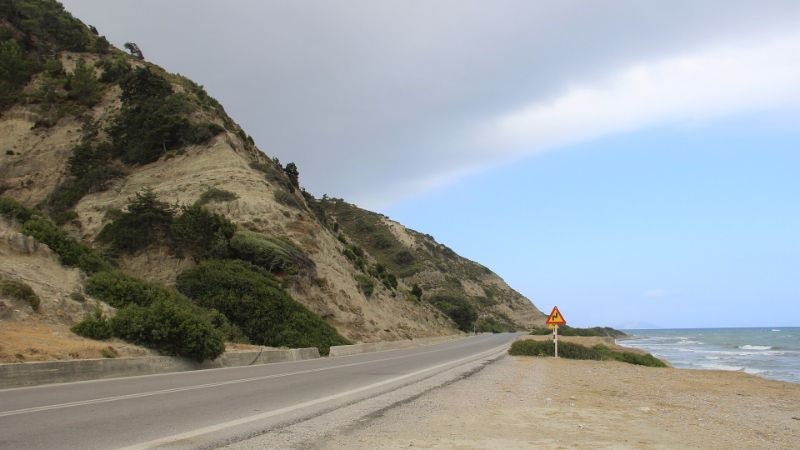
The busiest roads follow the coast. On the east side, the main road links Rhodes Town with Faliraki, Kolymbia and Lindos; on the west, the coast road runs past the airport and on towards Kamiros. Both are paved, easy to follow and get busier the closer you get to Rhodes Town.
Inland, the island rises into hills and the roads change character. Expect narrower lanes, tight hairpins, steep climbs and places where two cars need to slow right down to pass. Allow more time than your map app suggests, and on long descents use a lower gear rather than riding the brakes.
In rural areas you may come round a bend to find a tractor, a delivery van or animals on the road. Some side roads to beaches also turn into gravel or dirt, and tyres and the underside of the car aren’t covered by our insurance, so if a track looks rough, park and walk. For beaches you can drive right up to, see Rhodes beaches by car.
Rhodes Town: traffic and parking

Rhodes Town has the heaviest traffic on the island and the hardest parking, especially in high season. Driving in is fine; finding a space close to where you want to be is the real challenge.
The medieval Old Town is largely closed to cars, and its lanes were never built for them anyway. Park beyond the walls and continue on foot through one of the gates. If your satnav tries to send you inside the walls, ignore it.
Use marked parking spaces, check any signs for paid parking or time limits, and keep clear of bus stops, bus lanes and driveways. A parking ticket on a hire car is the renter’s to pay, just like any other fine.
Parking in Lindos
Visitors can’t drive into the village of Lindos itself, so you leave the car outside and walk the rest of the way. On summer days the closest spaces go early, so set off in good time, and follow the signs to the car parks rather than trying your luck in the narrow lanes. Our page on a day trip to Lindos has more on planning the visit.
Filling up
Petrol stations are easy to find around Rhodes Town, near the airport and along the main coastal roads. In the far south and up in the hills there are fewer of them, so fill up before a long day out, particularly if you’re heading down to Prasonisi, where the island ends.
Before you fill up, check whether your car runs on petrol or diesel: our car list shows the fuel for every model. And remember the fuel level you started with, since that’s the level we ask you to bring the car back at.
If you break down or have an accident
If the car breaks down, pull over somewhere safe and visible, switch on the hazard lights and, if you have to stop on the carriageway, place the warning triangle well behind the car. Greek law requires every car to carry a triangle, a first-aid kit and a fire extinguisher. Then ring +30 694 642 3869, day or night, and tell us exactly where you are.
After an accident, these steps help:
- If anyone is hurt, call 112, the European emergency number, straight away. In Greece you can also reach the police on 100 and an ambulance on 166.
- Make the scene safe: hazard lights on, triangle out, and everyone well away from passing traffic.
- Phone us before you sign any form or accept blame, and we’ll talk you through what happens next.
- Take photos of both cars, their number plates and the scene, and note the other driver’s name, phone number and insurance company.
- Stay at the scene until the details have been exchanged and, if they’ve been called, the police have arrived.
Before you set off
Save our number in your phone, keep your licence with you whenever you drive, and check that everyone who will take the wheel is on the rental agreement. Our insurance guide explains what is and isn’t covered, and the rental checklist sums up the age rules, the ways to pay and how delivery works. When you’re ready, book your car and we’ll deliver it wherever you’re landing or staying.