Driving to Prasonisi and the wild south of Rhodes
Prasonisi is as far south as you can drive on Rhodes. A low strip of sand links the island to a rocky islet with a lighthouse, with lively Aegean waves on one side and calm Mediterranean water on the other. Getting there takes you through the wild south, a land of small villages, bare hills and long, empty beaches.
It is a full day out, and the far south has fewer petrol stations, shops and shady spots than the busy resorts further north. Here is how to plan the drive, and how to stay within our rental terms where the asphalt gives way to sand.

The route south
From Rhodes Town or the airport, follow the main east coast road past Lindos and on through Lardos, Kiotari and Gennadi. Beyond Gennadi the road leaves the sea and heads inland to Kattavia, the closest village to the cape, where a signposted road of about 10 km winds down to Prasonisi.
From Rhodes Town it is roughly 90 km, which means about one and a half to two hours of driving in each direction without stops; from Lindos it is around 40 km, under an hour. On the way back you can retrace your route, or loop round by the west coast through Apolakkia and Monolithos and then north past Kamiros. The loop is longer and has more bends, so only take it if you have plenty of daylight left.
Villages on the way
The south is the quietest part of Rhodes, and a few short detours show you a different side of the island.
- Asklipio, inland from Kiotari: a hill village with an 11th-century Byzantine church, its walls covered in frescoes, and the ruins of a Knights’ castle above it.
- Gennadi: the main village of the south, beside a long, open beach.
- Lachania, just off the main road: a traditional village whose little square is shaded by a huge plane tree, ideal for a coffee stop.
- Kattavia: a small farming village and the nearest one to the cape. On the road from there to the beach you pass the site of ancient Vroulia.
Prasonisi: two seas and a sandbar
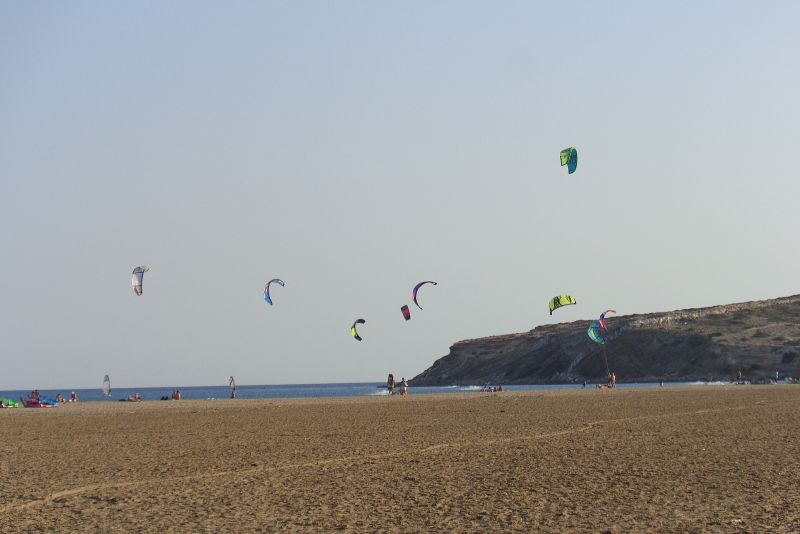
The name means “green island” in Greek. In summer, when the sea is low, a wide tongue of sand joins the islet to Rhodes; in winter the water usually covers it and Prasonisi becomes an island again. On calm summer days you can walk across and up towards the lighthouse at its southern end.
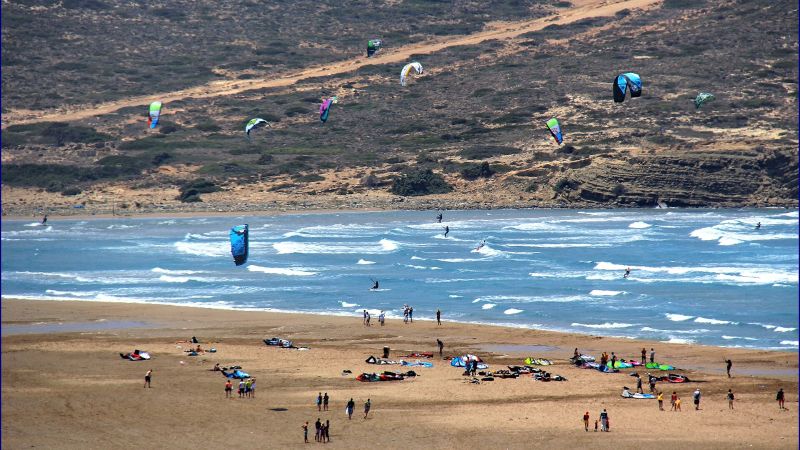
On the western, Aegean side the wind usually builds waves that suit experienced windsurfers and kitesurfers, while the eastern, Mediterranean side is much flatter and better for beginners and swimmers. The wind here is known for blowing steadily rather than in gusts, and in July and August the schools on the beach are busy with lessons and board hire.
If you swim, stay on the calm side and well away from the boards and kites, and do not try to swim out to the islet when the wind is up, as the currents can be strong.
Road conditions in the south
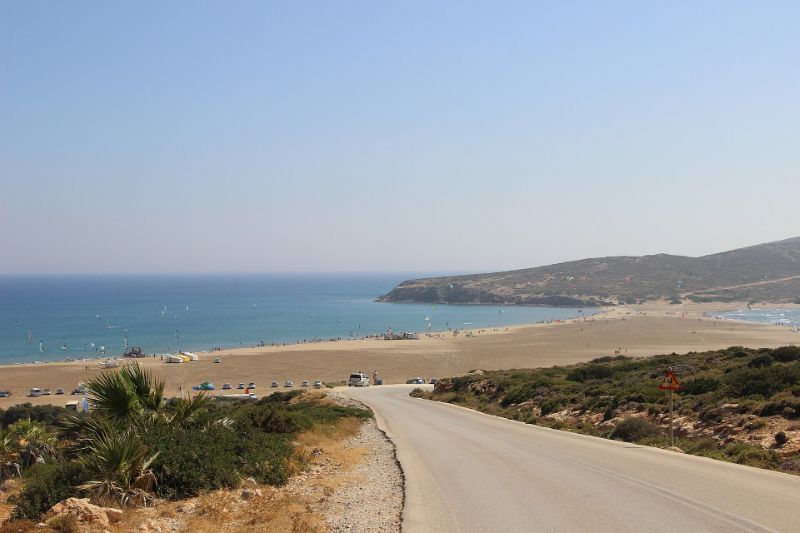
The main road down the east coast is asphalt all the way and in generally good condition, though further south it narrows and twists in places. The road from Kattavia to the cape is paved as well, but it winds across open ground and the last stretch is exposed to strong wind, so keep both hands on the wheel and your speed down.
Away from the main roads, many tracks in the south are gravel or dirt, and satnavs sometimes offer them as shortcuts. Stay on the asphalt, even when it looks longer on the map.
Sand, dirt tracks and your rental terms
Our rental terms include collision damage cover (CDW), but that cover does not extend to the tyres, windscreen, windows or underside of the car. Those are exactly the parts that suffer on stony tracks and in soft sand, so damage there would not be covered by the insurance.
So please do not drive onto the beach or the sandbar at Prasonisi, or down dirt tracks to remote coves. Leave the car in the parking area on firm ground and walk the last few metres: the sand is soft, cars do get stuck, and the cape is a protected nature area.
The same goes for every car on our car list, SUVs included. If you are unsure whether a road is suitable, call us on +30 694 642 3869, which is answered 24/7. For more on what is and is not covered, read our guide to car hire insurance in Rhodes.
What to bring
Pack the car the night before: beyond Gennadi the villages are small and there is little choice.
- A full tank. Petrol stations are far scarcer in the deep south than around the resorts, so fill up before you leave the east coast. And remember that the tank should be as full on return as it was at pick-up.
- Water and food. There are seasonal tavernas and a shop or two at the cape, but the villages on the way are small.
- Your own shade. Natural shade at the cape is scarce, so bring a beach umbrella you can anchor firmly, hats and plenty of sun cream.
- A warm layer and a hair tie. The wind can be strong even on hot days, and it carries sand.
Planning the day
Set off in the morning to enjoy the cape before the afternoon wind is at its strongest, or stay for the sunset if you are happy to drive back in the dark. July and August are the busiest months on the calm side; May, June and September are quieter and still warm.
On a long day like this it helps to share the driving: you can add up to two additional drivers when you book. We can deliver the car to your accommodation at no charge, whichever part of the island you are staying in, and you can book online; if you need to cancel, there is no charge until 48 hours before pick-up.